
The Upper Manyame Sub-Catchment Council successfully commissioned the Muronzi and Ditima Village Business Units in two separate ceremonies, marking significant milestones in its ongoing commitment to sustainable water resources management and rural socio-economic development. The events brought together government representatives, traditional leadership, technical experts, stakeholders, and beneficiary communities, reflecting a shared vision of transforming livelihoods through responsible and productive water use.

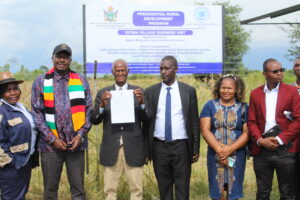
Dignitaries pose for pictures after handover ceremonies
At both Muronzi and Ditima, the commissioning ceremonies underscored the Council’s evolving role not only as a regulator of water resources, but also as a strategic development partner working to strengthen food security, promote rural industrialization, and enhance community resilience in the face of climate variability.
Representing the Upper Manyame Sub-Catchment Council Board, Councillor Gata emphasized that the projects were long-term investments whose sustainability depended on disciplined management and strong community ownership.

Clr Gata Delivering remarks on behalf or UMSCC Board
“The project now belonged to the community and that its success would be measured not by the speeches, but by how effectively it would be maintained, protected, and expanded,” said Councillor Gata, while addressing the Muronzi community.
He urged beneficiaries to safeguard the infrastructure, use water responsibly, uphold unity and transparency and ensure that the garden contributed meaningfully to community development.
Delivering remarks at Ditima, he reiterated the same message of responsibility and sustainability, urging beneficiaries to ensure disciplined management of the infrastructure for the benefit of future generations.
The Guest of Honour, Honorable MP Dr. Munyaradzi Kashambe, underscored the central importance of water in development.
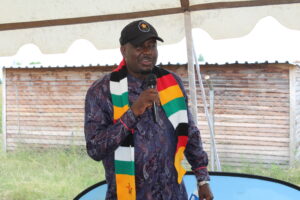
Guest of honor Hon MP, Dr. Munyaradzi Kashambe
“Water is life,” said Dr. Kashambe, emphasizing that access to reliable water supplies remained fundamental to rural industrialization, agricultural productivity, and improved household incomes.
Chief Seke, who was one of the key speakers at the Muronzi ceremony, commended the collaborative efforts between UMSCC, Government and traditional leadership. He encouraged the community to protect the project and work together for its success.

Chief Seke, applauding UMSCC for a great work
“This project is a blessing to our people. Let us protect it, work together, and ensure that it uplifts every household in Muronzi,” said Chief Seke.
Speaking on behalf of UMSCC management at the commissioning ceremonies, Mrs. Matsaira stressed the importance of environmental protection and disciplined water use to guarantee sustainability.

Water Resources Manager Mrs Matsaira, delivering remarks during the VBU handovers
“I encourage the community to continue working together to maintain the facility.
“Protect the borehole, safeguard the solar equipment and ensure disciplined water use.
“Environmental protection must remain a priority, as healthy ecosystems are essential for groundwater recharge and long-term sustainability,” said Mrs. Matsaira.
On behalf of the Ministry of Lands, Agriculture, Fisheries, Water and Rural Development, Hydrogeologist Lawrence Ndere expressed appreciation for UMSCC’s leadership and technical commitment during both occasions.
“On behalf of the Ministry, I express our sincere appreciation to the Upper Manyame Sub-Catchment Council, its leadership and all stakeholders who contributed to the success of these initiatives.
“Their dedication and commitment to sustainable water resources management and community development were highly commendable,” said Hydrogeologist Ndere.
He further urged the beneficiary communities to take full ownership of the infrastructure.
“I urged the beneficiary communities to take full ownership of the infrastructure, safeguard it and ensure its proper operation and maintenance so that it continued to benefit present and future generations,” he added.
The commissioning of the Muronzi and Ditima Village Business Units by the Upper Manyame Sub-Catchment Council was firmly anchored in the broader national development framework, particularly National Development Strategy 2 (NDS2) and Vision 2030.
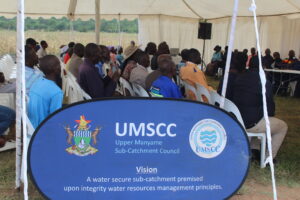
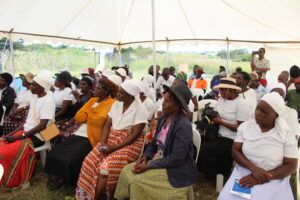
village business Unit Handover congregation
The projects demonstrated practical implementation of Government’s commitment to achieving an upper middle-income economy by 2030 through enhanced food security, rural industrialization, climate resilience, and sustainable natural resources management.
By investing in solar-powered water infrastructure and community-driven irrigation systems, the Upper Manyame Sub-Catchment Council translated policy into tangible results, ensuring that water remains at the centre of inclusive socio-economic transformation and long-term environmental sustainability.